Interzone Imports Unlimited
Naked LunchInterzone Imports Unlimited is the pharmaceutical and import-export business of Marvie and Leif the Unlucky, a partnership whose grand commercial schemes repeatedly resolve into delay, mutual suspicion, and dubious goods. Its proposed whale-derived lubricant deal condenses the company’s world: a quarantined cargo, a contested commission, improvised intermediaries, and a payment that remains remote even after Marvie obtains a check.
Business and Commercial Methods
The company specializes in pharmaceuticals and also operates a round-the-clock venereal-disease station offering six-way coverage. That combination makes its trade less a matter of a single legitimate product line than of opportunistic brokerage: Marvie and Leif pursue whatever sale, service, or commission appears available, moving between medicine and the surrounding business of sexual health.
One conspicuous proposal involves a shipload of K.Y. made from whale dreck in the South Atlantic. The material is described as rejected matter left over from cutting up and rendering a whale, a fishy waste product for which no use had been found. The cargo is under quarantine by the Board of Health in Tierra del Fuego, but the partners see the restriction not as a reason to abandon the deal but as an opportunity to earn a commission. The contrast between the supposedly useful lubricant and its unwanted raw material gives their enterprise its characteristic mixture of commercial optimism and compromised goods.
The Whale-Dreck Deal
Marvie and Leif commit themselves to the proposed transaction, then build a service network around it. They arrange what the narrative calls unmentionable services for a Greek shipping agent with a spastic condition and for an entire shift of customs inspectors. The deal therefore depends not only on finding a buyer for an unusual cargo but also on cultivating intermediaries and overcoming the obstacles posed by shipping and customs.
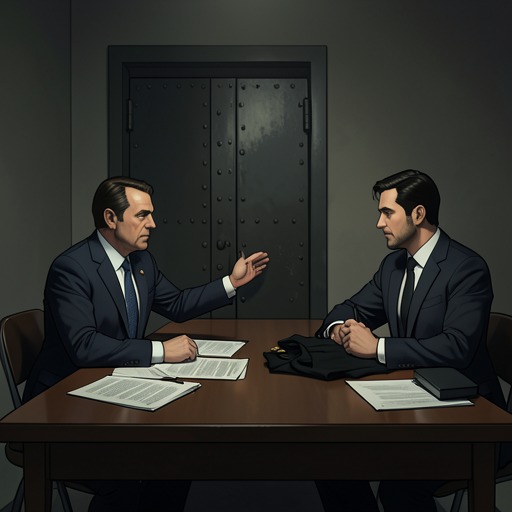
The partners’ cooperation soon gives way to a dispute over who deserves the commission. At the embassy, they accuse one another of trying to cheat the other, with Leif invoking possession of the bill of lading and Marvie insisting that he identified the opportunity. Their quarrel is sent to a department that refuses to hear about it, and they are ushered out through a back door into a vacant lot. The dispute does not end the partnership: they shake hands without enthusiasm and exchange a perfunctory kiss, a truce that allows the transaction to continue without resolving its underlying distrust.
Payment, Delay, and the Partnership
The business proceeds at a pace measured in months. The partners bring in the Expeditor, and Marvie eventually emerges with a check for forty-two Turkestan kurds, drawn on an anonymous South American bank and routed through Amsterdam. Clearing it is expected to take about eleven months. The check is thus both the visible proof of a successful commission and a sign that the proceeds remain distant and uncertain.
In the cafes of the Plaza, Marvie shows people a photostatic copy rather than the original. He explains that he cannot afford to buy himself a drink: he has already spent every kurd on Penstrep for Ali, who is again suffering from a sexually transmitted infection. The episode links the company’s pharmaceutical trade to personal obligations and exposes the gap between its apparent success and its actual liquidity. Marvie’s check can be displayed, but the money it represents cannot yet support even a small celebration.
When Marvie does buy a small beer, he produces a blackened coin from his clothing and tells the waiter to keep the change. The waiter sweeps the coin away and leaves; Marvie interprets the response as envy of his check. The scene closes the deal’s comic arc without converting its nominal success into comfort: a months-long transaction, international banking routes, and an elaborate commission end with a payment that is not spendable and a celebration financed by a single worthless-looking coin.
Significance
Interzone Imports Unlimited presents trade as a chain of compromised materials, personal favors, paperwork, and delayed credit. The whale-dreck cargo begins as unwanted residue, passes through quarantine and a web of intermediaries, and culminates in a check that must travel across continents before it can become money. Each stage creates another occasion for bargaining or delay, while the partners’ quarrel shows that even a shared enterprise cannot secure trust over its proceeds.
The company’s pharmaceutical specialization gives this commercial absurdity a practical consequence: Marvie’s eventual claim to success is set against the money already spent on medicine for Ali. Business, bodily need, and personal expense are not separate spheres here. The enterprise’s characteristic achievement is instead a paper promise whose value is measured against immediate costs, an uncertain clearing period, and the inability to buy a drink when the deal is supposedly done.